


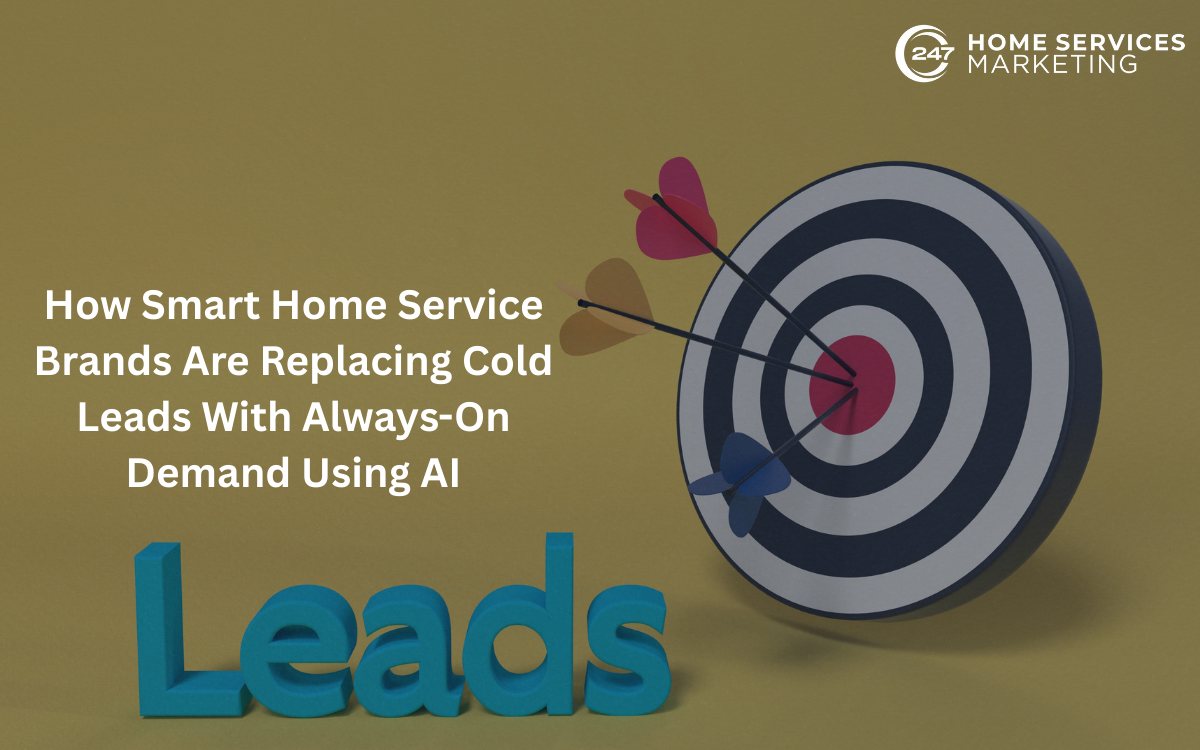
The smart home services industry is experiencing a seismic shift. In 2025, forward-thinking brands are abandoning the outdated cold lead chase and embracing something far more powerful: AI-driven, always-on demand generation. This transformation isn’t just changing how businesses attract customers; it’s fundamentally redefining the relationship between service providers and homeowners.
The Death of Cold Leads: Why Traditional Methods Are Failing
For decades, home service companies relied on a predictable playbook: door-knocking, yellow pages ads, generic online directories, and purchasing leads from third-party aggregators. Traditional home services marketing followed this same worn path, with companies investing heavily in generic campaigns that cast wide nets, hoping to catch a few interested prospects. These methods shared a fatal flaw: they generated cold leads that required extensive nurturing, had low conversion rates, and consumed massive amounts of sales team bandwidth.
Modern customers don’t flip through directories or wait for business hours; they start with Google searches like “emergency plumber near me,” check multiple websites, read reviews, and increasingly prefer texting over phone calls. The customer journey has evolved, but many businesses haven’t kept pace. This is precisely where digital marketing for home services has become critical, as the entire discovery and evaluation process now happens online before a customer ever picks up the phone.
The numbers tell a sobering story. Traditional lead generation methods typically see conversion rates hovering between 5 and 15%. Meanwhile, businesses using AI chatbots experience a thirty to fifty percent increase in lead conversion rates, with response times improving by fifty percent compared to traditional web forms. Companies partnering with a specialized SEO agency for home services are discovering that combining search visibility with AI-powered conversion tools creates a powerful competitive advantage. Getting found is only half the battle; converting visitors instantly is where AI dominates.
The AI Revolution: From Reactive to Proactive
The smart home services sector is uniquely positioned to capitalize on AI’s capabilities. With the global AI in smart home technology market valued at over $15 billion in 2024 and projected to exceed $100 billion by 2034, the convergence of smart home adoption and AI-powered business tools creates unprecedented opportunities.
Predictive Analytics: Knowing What Customers Need Before They Ask
AI-powered predictive analytics enables businesses to anticipate customer needs based on historical data and behavior patterns, identifying high-intent customers who repeatedly visit specific service pages and predicting seasonal demand spikes. Instead of waiting for homeowners to reach out, smart service brands proactively target potential customers at precisely the right moment.
Consider an HVAC company using AI to track website behavior. When a homeowner visits their furnace installation page multiple times during early autumn, the system doesn’t just log the data; it triggers personalized outreach, recognizing that this visitor is likely preparing for winter and researching options. This transforms cold outreach into warm, timely engagement.
Conversational AI: The 24/7 Sales Team That Never Sleeps
Modern conversational AI systems have evolved from rigid, command-based interactions into intuitive, context-aware companions that anticipate needs and respond with human-like understanding. For smart home service brands, this means capturing leads around the clock without adding headcount.
AI chatbots deployed on websites and integrated across messaging platforms handle the entire qualification process. They ask targeted questions, schedule appointments directly through integrated calendars, and even provide instant quotes based on customer inputs. These systems can set appointments, manage support tickets, and communicate through multiple channels, including text, video calls, and social media.
What makes this particularly powerful is context retention. Unlike traditional chatbots that reset with each conversation, modern AI assistants remember previous interactions, creating continuity that builds trust and accelerates the sales cycle.
Smart Lead Scoring: Focusing Energy Where It Matters
Not all leads are created equal, and AI excels at identifying which prospects deserve immediate attention. Predictive AI analyzes vast amounts of data, including website behavior, demographic information, and comparisons to historical customer conversion patterns, then assigns scores indicating the likelihood to become paying customers.
This intelligence enables service brands to slash their cost per lead by up to fifty percent by eliminating wasted effort on low-quality prospects. Sales teams receive enriched lead profiles with AI-generated insights about the customer’s needs, preferences, and optimal engagement strategies.
Building Always-On Demand: The New Operating Model
Smart home service brands leading this transformation aren’t just implementing isolated AI tools; they’re creating integrated ecosystems that generate constant, high-quality demand. This represents the evolution of home services marketing from periodic campaigns to continuous engagement engines that work around the clock.
1. Multi-Channel AI Presence
The modern customer journey is fragmented across channels. AI enables brands to maintain a consistent, intelligent presence everywhere customers might be:
- Website AI Agents: Instant engagement for every visitor, with personalized conversations based on browsing behavior
- SMS and WhatsApp Bots: Meeting customers in their preferred messaging apps with quick responses and booking capabilities
- Social Media Integration: Automated lead capture and qualification across Facebook, Instagram, and other platforms
- Voice-First Interfaces: Voice assistants enable users to set appointments, make inquiries, and control services through casual conversation, particularly helpful for accessibility
2. Dynamic Audience Targeting
AI audience management enables businesses to filter prospects by homeowner demographics and property insights, matching custom audiences on social platforms without requiring outside agencies. This precision targeting means smart home brands can identify homeowners whose properties and profiles perfectly match their ideal customer criteria.
For example, a smart home security installation company can target homeowners in specific neighborhoods with homes built in certain years, particular value ranges, and demographic profiles indicating technology adoption and security consciousness, all managed automatically by AI systems.
3. Automated Nurture Sequences
AI doesn’t just capture leads, it nurtures them through personalized, behavior-triggered email sequences. AI tracks website visits and sends relevant follow-up emails about related services, with dynamic content personalization based on engagement patterns.
These aren’t generic drip campaigns. The AI analyzes which content each prospect engages with, adjusts messaging timing based on individual response patterns, and can even determine the optimal day and hour to send messages for maximum open and click-through rates.
Real-World Results: What Success Looks Like
The transformation from cold leads to always-on demand generates measurable business impact:
Response Speed: Seventy-eight percent of customers expect responses within an hour. AI ensures instant engagement, dramatically increasing conversion likelihood.
Lead Volume Growth: Companies implementing comprehensive AI strategies report lead volume increases of seventy percent or more within the first year, with continued thirty percent annual growth as systems learn and optimize.
Cost Efficiency: By improving lead quality and conversion rates while reducing manual qualification effort, smart service brands achieve a fifty percent reduction in cost per acquisition.
Revenue Acceleration: Organizations using AI-powered lead scoring systems experience significant conversion rate improvements, with companies reporting a higher likelihood of revenue growth from AI implementation.
The Technology Stack: What Powers Always-On Demand
Building this capability requires integrating several AI technologies:
· Natural Language Processing (NLP)
NLP enables AI to identify and learn human language patterns from big textual datasets, then interpret user inputs and formulate relevant responses, providing more accurate intent recognition than traditional rule-based bots. This is what allows conversational AI to understand customer requests phrased in dozens of different ways and respond appropriately.
· Machine Learning Models
Behind the scenes, machine learning algorithms continuously analyze conversion data, identifying patterns that humans might miss. These models predict which marketing messages will resonate with specific customer segments, determine optimal ad spend allocation, and automatically adjust campaigns based on performance.
· Integration Platforms
The most successful implementations connect AI tools with existing business systems, CRM platforms, scheduling software, payment processors, and marketing automation tools. This integration ensures that insights gained through AI interactions immediately inform business operations and customer relationship management.
Overcoming Implementation Challenges
While the benefits are compelling, smart home service brands face real challenges when adopting AI-driven demand generation:
· Data Quality and Volume
AI systems require substantial data to function effectively. Companies with limited historical customer data may need to start with simpler AI applications and progressively adopt more sophisticated tools as their data library grows.
· Team Training and Change Management
AI implementation requires a clear understanding of where leads originate, optimization of response systems, and proper lead tracking to measure improvements. Success depends on teams’ understanding how to work alongside AI tools rather than viewing them as replacement technology.
· Balancing Automation with Human Touch
The most effective strategies blend AI efficiency with human expertise. AI handles qualification, scheduling, and routine questions, but complex consultations and relationship building still benefit from human involvement. Finding the right handoff points maximizes both customer satisfaction and operational efficiency.
The 2025 Playbook: Getting Started
For smart home service brands ready to transition from cold leads to always-on demand, here’s a practical roadmap:
Phase 1: Foundation Building (Months 1-2)
- Audit current lead sources and conversion rates
- Implement AI chatbots on high-traffic pages
- Begin collecting behavioral data
- Set up basic lead scoring models
Phase 2: Expansion (Months 3-6)
- Deploy multi-channel AI presence across social and messaging platforms
- Implement predictive analytics for proactive targeting
- Create automated nurture sequences
- Integrate AI tools with existing CRM systems
Phase 3: Optimization (Months 7-12)
- Refine AI models based on conversion data
- Expand to advanced features like voice AI and visual quoting
- Implement geo-targeting and property-based audience segmentation
- Deploy AI-powered storm and seasonal demand prediction
Looking Forward: The Competitive Imperative
The transition from cold leads to always-on demand isn’t just an opportunity; it’s becoming a competitive necessity. As approximately forty percent of U.S. adults aged eighteen to sixty-four used generative AI in 2024, with usage being slightly higher at home than at work, customer expectations are being shaped by AI interactions across their digital lives.
Smart home service brands that embrace AI-driven demand generation gain compounding advantages. Their systems continuously learn and improve, their customer acquisition costs decrease while competitors’ rise, and they build databases of customer insights that further enhance targeting precision.
The question isn’t whether to adopt AI for demand generation; it’s how quickly you can implement it before competitors establish insurmountable advantages.
Conclusion: From Hunters to Magnets
The fundamental shift happening in smart home services is one of positioning. Traditional businesses act as hunters chasing cold leads, making countless calls, hoping to find customers ready to buy. AI-powered brands become magnets attracting ready-to-convert prospects through intelligent, always-on systems that identify intent, engage instantly, and nurture relationships at scale.
This transformation aligns perfectly with broader smart home market growth. With the global smart home market valued at over one hundred twenty-one billion dollars in 2024 and projected to reach over six hundred thirty-three billion by 2032, the addressable market for smart home services is expanding rapidly.
The brands that will dominate this growing market aren’t those with the biggest sales teams or advertising budgets; they’re the ones leveraging AI to create always-on demand engines that consistently deliver qualified, ready-to-buy customers. The technology exists, the playbook is proven, and the competitive advantage awaits those bold enough to implement it.
The era of cold leads is ending. The age of always-on AI-driven demand has begun. The only question is: which side of this transformation will your business be on?